

Do you need aortic valve surgery?
There’s a Less Invasive Way.
Our unique keyhole approach replaces your valve with no broken bones, no large scars, and a faster recovery
Request your Aortic Valve review
2 Weeks
is the average surgery wait time*
1500
minimally invasive procedures
100+
5-star patient reviews. Read now
35 Years
of clinical and surgical experience


*Surgery is typically offered within two weeks of a decision that surgical treatment is appropriate, safe, and fully assessed.


*Surgery is typically offered within two weeks of a decision that surgical treatment is appropriate, safe, and fully assessed.


Smaller Incisions. Less Pain. Reduced Trauma. Quicker Recovery.
Benefits of Keyhole Aortic Valve Replacement
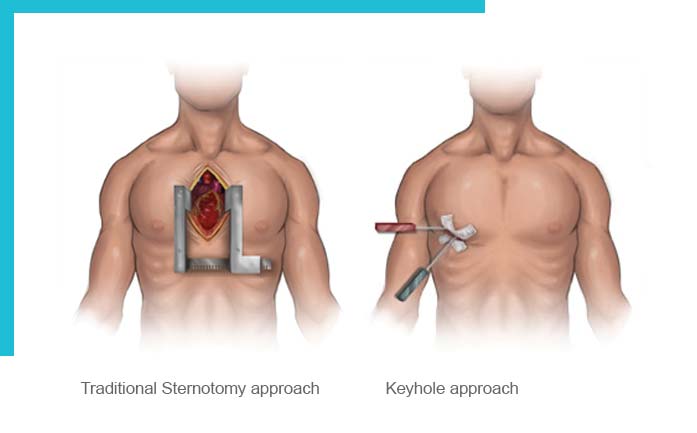
Traditional aortic valve repair or replacement uses a large chest incision and splits the breastbone.
This incision needs wiring together after the surgery and takes 12 weeks to heal meaning that recovery following this operation is prolonged.
Keyhole aortic valve replacement offers several benefits over traditional open-heart surgery through the breastbone.
✅ No broken breastbone
✅ Minimal pain and blood loss
✅ Faster hospital discharge
✅ Safer in re-do and older patients
Our most advance surgical treatment invloves no broken bone since we approach the aortic valve through a small cut between the ribs on the right side of the chest. This is called ARTAVR.
This treatment will allow you to recover in a matter of days rather than months and produces less pain, less risk of infection, less bleeding and swifter mobility when performed by experts.
By opting for keyhole aortic valve replacement, performed by experienced teams, patients can enjoy a faster and smoother recovery, while still receiving the same excellent outcome of traditional open-heart surgery.
Mr Birdi Explains Keyhole Aortic Valve Replacement

HIGHLY EXPERIENCED & SKILLED SURGEONS
Why You Should Choose The Keyhole Heart Clinic
At The Keyhole Heart Clinic my team and I are proud to have assembled the most highly experienced and skilled surgeons, anaesthetists and allied professionals specializing in minimally invasive aortic valve replacement in the United Kingdom.
Every member of the team has spent years perfecting their craft and have a track record of delivering exceptional results.
And we don’t just stop at providing world-class surgical care. We understand that heart health is a journey that extends beyond the operating room. That’s why we are committed to providing personalized care and support every step of the way.
FREQUENTLY ASKED QUESTIONS
Aortic Valve Replacement
What is aortic valve disease?
Your heart has a valve called the aortic valve. Think of it like a door that opens and closes with every heartbeat, letting blood flow out to the rest of your body. When that door gets stiff and narrow – that’s aortic stenosis. When the doors turn the wrong way – that is called aortic regurgitation or leak.
Because the door can’t open properly, your heart has to work much harder to push blood through. Over time, this extra strain causes symptoms like breathlessness, tiredness, chest tightness, and dizziness. If it’s left untreated, it can lead to heart failure and heart chamber enlargement.
Severe aortic stenosis is serious. Once symptoms appear, the outlook without treatment deteriorates quickly. The good news is that aortic valve replacement surgery – particularly the keyhole approach – can restore normal blood flow, relieve symptoms, and give you your quality of life back.
Severe aortic regurgitation is also very important and is often missed until heart enlargement occurs.
Both conditions need to be carefully monitored over time with regular heart scans in order to time the perfect moment for treatment.
Bicuspid aortic valve disease is a defect that you are born with where the aortic valve is made up of two leaflets instead of three. Bicuspid aortic valve often become stenotic or leak earlier than three leaflet valves. Bicuspid valve disease is often associated with aortic aneurysm formation (aorta pipe swelling) and requires specialist assessment. Bicuspid valve disease can also be treated effectively using keyhole aortic valve surgery, even when it is associated with an aortic aneurysm.
What is keyhole aortic valve replacement and how does it work?
Keyhole aortic valve replacement – also called minimally invasive aortic valve replacement or ARTAVR – is a way of replacing your faulty aortic valve without having to crack open your breastbone.
Instead of a large cut down the middle of your chest, the surgeon makes a small incision between the ribs on the right side. Through that small opening, the old, damaged valve is removed and a new one put in its place. You are on a heart-lung bypass machine during the operation, just as with traditional surgery – but the recovery is dramatically different.
Because no bones are broken, the wound heals in around 7–10 days. Most patients are home within a few days of surgery and back to normal life within 3–4 weeks as opposed to 3 months following traditional breastbone cut.
What is the difference between keyhole and open-heart surgery for an aortic valve replacement?
Traditional open-heart surgery uses a large cut straight down the middle of your chest, and the breastbone is split apart to get to the heart. After the operation, the bone has to be wired back together – and that takes around 12 weeks to heal. Recovery is long, painful, and limits what you can do.
Keyhole aortic valve replacement uses a small incision between the ribs. No bone is broken. The key differences are:
- Much smaller scar – a few centimetres rather than the full length of your chest
- Less blood loss during surgery
- Less pain afterwards
- Lower risk of wound infection
- Home within a few days rather than weeks
- Back to normal activities in 3–4 weeks rather than 12
The heart operation itself achieves the same result – a new, working aortic valve – but the impact on your body is far smaller.
Am I a good candidate for keyhole aortic valve replacement? And who might not be suitable?
The great news is that most people who need an aortic valve replacement are suitable for the keyhole approach — particularly when the surgery is performed by an experienced specialist team like ours.
You are likely to be a good candidate if:
- You have been told you need an aortic valve replacement
- You are in reasonable general health
- Your heart anatomy is suitable – we assess this from your scans
- You have had heart surgery before – keyhole is often the safer option for re-do operations
- You are older – the gentler approach makes it particularly well suited to elderly patients
Most patients are suitable. However, in some cases a different approach may be recommended – for example, if multiple procedures are needed at the same time, or if your scans reveal a specific anatomical factor. Some other health conditions may also affect eligibility.
If you have been told elsewhere that keyhole surgery is not an option for you, it is always worth asking for a second opinion. We have helped many patients who were initially turned away from the keyhole approach. The only way to know for certain is through a proper assessment.
Is keyhole aortic valve surgery a safe option if I am older or have other health conditions?
Yes – and in fact, the keyhole approach is often particularly recommended for older patients and those with other health conditions.
Traditional open-heart surgery involving a breastbone split is a physically demanding operation. For older patients, the trauma of that procedure — the blood loss, the extended time in hospital, the restricted recovery – can carry additional risks.
Because keyhole surgery is gentler on the body, it avoids many of these concerns:
- Less blood loss means less stress on the heart and other organs
- Shorter hospital stay reduces the risk of hospital-acquired infections
- Faster mobilisation means patients get up and moving sooner, which matters enormously in older age
- No broken breastbone means less pain and a faster return to independence
Mr Birdi has extensive experience operating on elderly patients and those with complex medical histories. Age alone is not a barrier to keyhole surgery. Your suitability will be assessed individually, and we will always give you an honest picture of what we recommend for your specific situation.
Is keyhole aortic valve surgery better than traditional open-heart surgery?
For most patients, yes – in terms of how your body feels during recovery, the keyhole approach has real advantages over traditional open-heart surgery.
Here is what patients typically experience:
- A much smaller scar – a few centimetres between the ribs, rather than a long scar down the chest
- Less pain after surgery
- Less bleeding during the procedure
- Lower risk of infection
- Home within 3–5 days rather than a week or more
- Back to driving, working, and everyday activities in around 3–4 weeks – compared to roughly 12 weeks after a breastbone split
- Particularly beneficial for older patients and those who have had previous heart surgery
The outcome of the surgery – a working, healthy aortic valve – is the same. But the journey to get there, and the recovery on the other side, is far easier on your body.
How successful is keyhole aortic valve replacement? What are the outcomes?
Keyhole aortic valve replacement is a well-established, highly effective procedure. Its success rates are at least as good as traditional open-heart surgery – and in many patient groups, outcomes are better.
The vast majority of patients experience a significant improvement in quality of life after surgery – less breathlessness, more energy, and the ability to do things that the faulty valve had been preventing.
At The Keyhole Heart Clinic, Mr Birdi has performed over 2,000 minimally invasive heart procedures and nearly 8,000 heart operations in his career. He is recognised as one of the most experienced surgeons in this field in the United Kingdom, and our outcomes reflect that experience.
We are transparent about our results. Specific outcome data – including survival rates and recovery times – is available to discuss at your consultation.
Is keyhole aortic valve replacement recommended by medical guidelines?
Yes. NICE – the National Institute for Health and Care Excellence, which sets the standards for medical treatment across England and Wales – published guidelines in 2021 recommending that patients who are suitable for minimally invasive aortic valve replacement, or who would prefer it, should be referred to a specialist centre if that expertise is not available locally.
The Keyhole Heart Clinic is one of those specialist centres. Mr Birdi and his team have been performing this type of surgery for over two decades and are recognised as leaders in the field.
If you have been told that keyhole surgery is not available through your local hospital, NICE guidelines support your right to ask to be referred to a centre that can provide it.
How long does it take to recover from keyhole aortic valve surgery?
Recovery from keyhole aortic valve replacement is significantly faster than from traditional open-heart surgery.
Most patients follow a timeline roughly like this:
- In hospital: 3–5 days after surgery
- Home and moving around: from day one after discharge
- Wound healing: 7–10 days (no broken bone to heal)
- Driving: usually from around 4 weeks (subject to your consultant’s advice and DVLA guidance)
- Desk work or light activity: most patients return within 3–4 weeks
- Physical or manual work: longer – your team will advise based on your specific job
- Follow-up appointment: 6 weeks after discharge with Mr Birdi
By contrast, traditional open-heart surgery involving a breastbone split requires around 12 weeks before the bone heals – during which time lifting, driving, and many everyday activities are restricted.
Every patient recovers at a slightly different pace. During your consultation, we will give you a personalised picture of what your recovery is likely to look like.
Is it safe to have private heart surgery? What happens if something goes wrong?
Yes – we have everything covered 24/7.
Choosing to have your surgery privately does not mean choosing less safety. It means choosing more: more time with your surgeon, more speed, and – at The Keyhole Heart Clinic – access to one of the most experienced heart surgery teams in the country, operating within a hospital environment built to handle exactly this kind of procedure.
Here is what is in place to keep you safe:
- Mr Birdi has performed over 1,500 minimally invasive heart procedures and is recognised as one of the most experienced surgeons of his kind in the United Kingdom. Experience in a surgeon is not a luxury – it is a safety factor.
- Mr Birdi has personally handpicked every member of the team around you. Your anaesthetist, your perfusionist, your scrub team, your intensive care specialists – each has been selected from across the country for their expertise in this specific type of surgery. This is not a general surgical team that happens to be available. It is a team built around you.
- Your surgery takes place at Cromwell Hospital – one of the UK’s leading private hospitals with a fully equipped, 24-hour intensive care unit (ITU) staffed around the clock. If you need intensive care support at any point – before, during, or after surgery – it is immediately available.
- Highly trained cardiac surgeons and specialist heart staff are present in the hospital 24 hours a day, 7 days a week. There is no gap in cover. If anything requires attention at any hour, the right people are already there.
It is also worth keeping this in perspective: with a surgeon of Mr Birdi’s experience, the risk of a serious complication is already very low. But the entire point of the environment he has built is that if the unexpected ever did occur, you would be in exactly the right place, with exactly the right people.
We will walk you through every safety aspect of your care at your consultation – and encourage you to ask any question, however direct. Transparency is something we take seriously.
Will my private health insurance cover keyhole aortic valve surgery?
In most cases, yes. Keyhole aortic valve replacement is covered by all the major UK private health insurers, including BUPA, Vitality, Aviva, Cigna, and WPA.
We always recommend checking directly with your insurance provider before your consultation, as the exact coverage depends on your individual policy – for example, whether you have an excess, whether a specific hospital is included in your policy, and whether a referral letter from your GP is required.
Our team is experienced at working with all the major insurers and can help guide you through the process. We make sure there are no surprises.
How much does a consultation with Mr Birdi cost - and what is included?
A face-to-face consultation with Mr Birdi is £450. An online consultation is £325. There are no hidden charges.
Your consultation includes a thorough review of your clinical history and diagnosis, a discussion of all your treatment options, and a clear recommendation tailored to you. If surgical treatment is appropriate, Mr Birdi will explain exactly what the procedure involves, what to expect, and what your recovery will look like.
Following your consultation, your case is presented at our weekly multidisciplinary team meeting – a group of leading London heart specialists – to make sure every decision benefits from the collective experience of several senior doctors.
We offer consultations in London, Nottingham, and online. If you are unsure which option is right for you, our team is happy to advise.
How do I schedule an appointment for minimally invasive aortic valve replacement?
To schedule an appointment for minimally invasive aortic valve replacement, please fill in the form on this page or contact our office and speak to one of our patient coordinators who can guide you through the process.
What should I expect during my consultation for minimally invasive aortic valve replacement?
During your consultation, Mr Birdi will delve into your clinical history to confirm your diagnosis. We will then obtain any relevant images from your local hospital. If you need any further tests Mr Birdi will advise you of these. Your case history will then be presented at our weekly multidisciplinary meeting which consists of a group of the best heart specialists in London, to ensure that the decisions we make are subject to the clinical experience of several leading doctors.
What happens at my first consultation - what will Mr Birdi actually do?
Your consultation is NOT a rushed five-minute appointment. Mr Birdi will take the time to properly understand your situation, answer all your questions, and make sure you leave feeling informed and reassured.
Here is what to expect:
- A thorough review of your medical history and any previous test results or scans
- A clear explanation of your diagnosis in plain language – no jargon
- An honest discussion of your options, including whether keyhole surgery is appropriate for you
- Time to ask any questions you have – there are no silly ones
After your consultation, your case is presented at our weekly multidisciplinary team meeting, where a group of leading London heart specialists review the decision together. This means the recommendation you receive has the backing of several experienced senior doctors, not just one.
You are welcome to bring a family member or someone close to you to your appointment.
What happens after my surgery?
You will be discharged with plenty of information to help you to recover safely. You will then be seen in clinic 6 weeks post-discharge from hospital. Mr Birdi and the team at The Keyhole Heart Clinic are contactable at any time following your discharge from hospital and we can arrange to see you in clinic if required.
How quickly can I have my surgery?
We aim to schedule your surgery with two weeks of completing your workup and presenting your case at our multidisciplinary team meeting.


Contact Us
For general questions, please send us a message and we’ll get right back to you. You can also call us directly to speak with a member of our service team or insurance expert.